
The short answer
Almost every domestic solar PV installation in the UK needs scaffolding. Fitting panels takes days, not the minutes that justify ladder access, so a ladder is not a compliant way to do it under the Work at Height Regulations 2005. What you need is a boarded working platform at eaves level with a double guard rail and a toe board. In Kent, a single elevation solar scaffold on a standard two storey house typically runs £450 to £900 supplied, erected, hired and dismantled. Two elevations, a hip roof or a difficult approach pushes that to £900 to £1,600.
The part almost nobody tells homeowners is this. Most solar installers quote a scaffold sized for two days of panel fitting and nothing else. If the survey or the strip finds a cracked tile, a failed lead flashing or a chimney that needs attention, that scaffold is usually the wrong scaffold, and changing it mid job costs more than specifying it properly on day one.
Do you legally need scaffolding for solar panels?
There is no law that says “solar panels require scaffolding”. What there is instead is the Work at Height Regulations 2005, which require work at height to be planned, supervised and carried out by competent people, and which set a hierarchy: avoid the risk, prevent falls with collective protection, then mitigate the consequences.
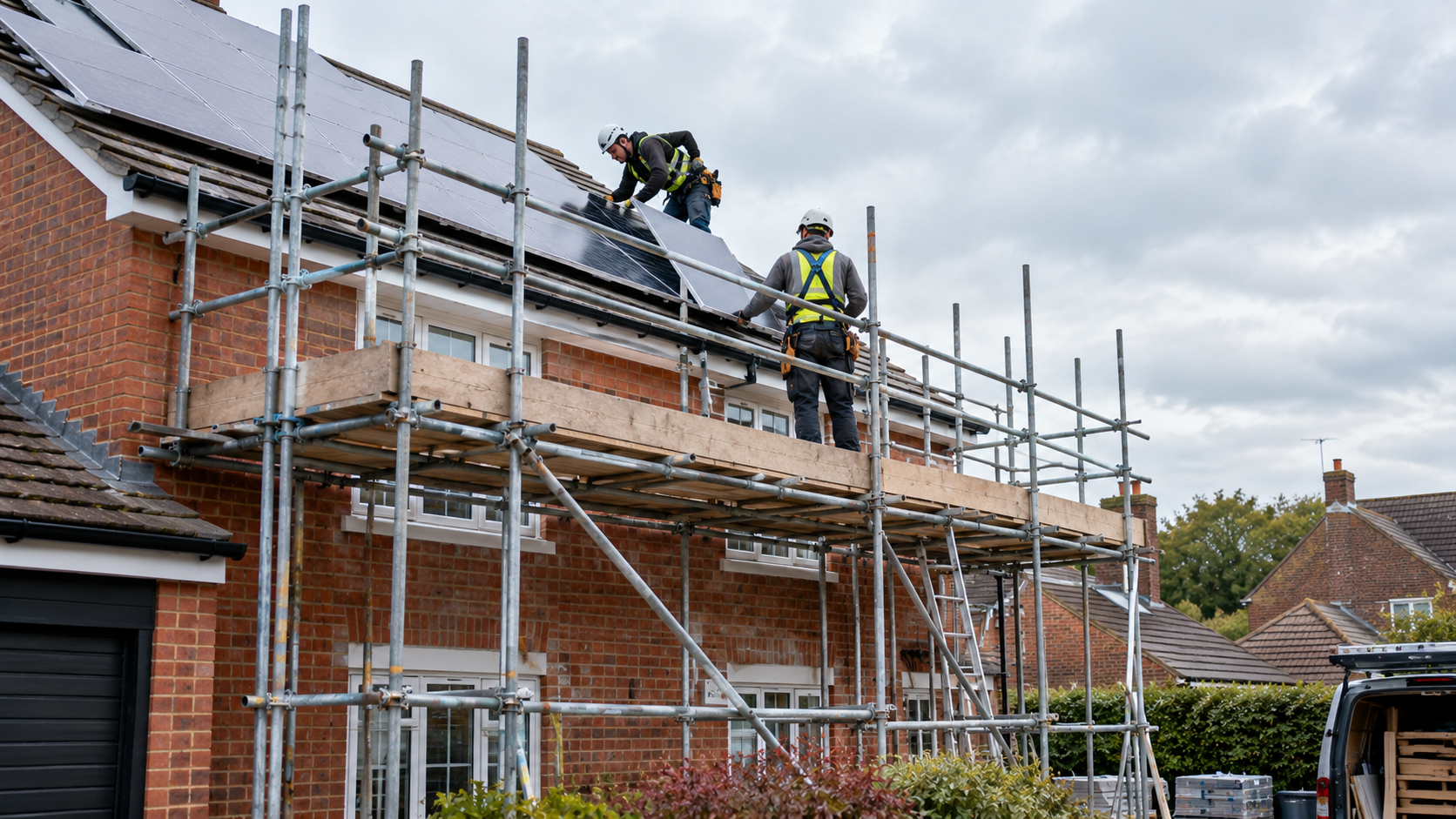
Applied to a pitched roof, that hierarchy lands on a working platform with edge protection almost every time. Risk is always the first test, but duration is the practical one. HSE advises that if a task would keep someone on a leaning ladder or stepladder for more than 30 minutes at a time, you should consider alternative equipment. A 12 panel install means carrying roughly 250kg of glass and aluminium onto the roof, fixing roof anchors, laying rails, clamping panels and running DC cabling. That is one to three days of work at height for two or three people, which is nowhere near the ladder threshold, so ladder access alone does not stand up.
Where a working platform is provided for construction work, Schedule 2 of the Work at Height Regulations sets out what it has to look like: a main guard rail at least 950mm above the edge, a toe board, and no gap of more than 470mm between the means of protection.
So the honest answer to “do I need scaffolding for solar panels” is: not because a solar rule says so, but because the access rules that apply to any roof work leave you nowhere else to go on a typical two storey house.
What does a solar panel scaffold actually look like?
The standard arrangement is an independent tied scaffold to the elevation carrying the panels, with the top working lift set just below the gutter line so operatives work off the roof with the guard rail at the correct height behind them. The lift needs to be wide enough to land and turn a panel, because a modern 430W to 500W module runs from roughly 1.7m to 2.1m long by about 1.13m wide and weighs 20kg to 28kg, and on a domestic job panels go up by hand.
Three details separate a scaffold built for solar from a generic access scaffold:
- Panel handling. Enough platform width and a sensible loading point. Panels landed awkwardly get scratched, dropped or leaned against standards where they crack.
- Ridge access. Optimisers, bird protection and in-roof trays often mean working at or near the ridge, not just the eaves. That can mean a higher top lift rather than the eaves level platform a fitter assumed.
- Cable route and inverter. If the inverter sits on an elevation with no scaffold, someone ends up on a ladder doing exactly the work the scaffold was meant to prevent.
For a broader picture of how these structures are put together, see our guide to the main types of scaffolding used in the UK.
Ladder, tower, cherry picker or scaffold? A straight comparison
| Access method | Suitable for a domestic solar install? | Why |
|---|---|---|
| Leaning ladder | No | A solar install runs for days, far beyond the 30 minute guide for ladder work. No platform, no edge protection, no safe way to carry panels |
| Mobile alloy tower | Rarely | Fine for an inverter or a survey. Too narrow to land panels, and it gives no continuous edge protection along the eaves |
| MEWP or cherry picker | Sometimes | Good on flat roofs, warehouses and open commercial sites. Needs hard standing and clear access, which most Kent housing does not have |
| Solar access scaffold, one elevation | Usually yes | The standard answer for a terrace or semi with panels on one pitch |
| Full independent scaffold, multiple elevations | Yes, when needed | Hip roofs, panels on two pitches, or solar combined with roof repairs |
| Roof edge protection system only | Occasionally | Used on new build plots where the scaffold is already on hire for the main build |
Who books the scaffold, you or the installer?
In most cases the solar installer arranges the scaffold and passes the cost through in the quote. That is usually the right arrangement, because the installer knows the panel layout and the install date, and a scaffold already standing on day one avoids a wasted visit.
But “included” is doing a lot of work in that sentence. Before you sign, ask the installer three questions:
- Is the scaffold priced as a separate line, and how much is it? If it is buried in a per kWp figure you cannot compare quotes and you cannot see what happens if the scope changes.
- Which elevations does it cover, and to what height? A quote priced off aerial imagery frequently misses a rear extension, a conservatory, a lean to or a side return that the fitters will need to reach.
- What is the hire period, and what is the weekly extension rate? This is the number that bites when an install slips.
Booking the scaffold directly is better in four situations: you are already having roof work done, the property is listed or in a conservation area, the scaffold will sit over a public footway, or you are coordinating several trades. In each of those, dealing with the scaffolding contractor yourself gives you control over the design, the dwell time and the licence.
How much does solar panel scaffolding cost in Kent?
| Property and layout | Indicative supplied, erected, hired and dismantled | What drives the price |
|---|---|---|
| Mid terrace, panels on one pitch, rear access | £450 to £750 | Access for the wagon, handballing materials through the house or an alley |
| Two storey semi, one elevation | £550 to £900 | Gable returns, conservatory or lean to obstructions |
| Detached, hip roof, panels on two pitches | £900 to £1,600 | Two or more runs, more ties, more boards |
| Any property needing a highway or footway licence | Add the council licence fee plus set up | Pavement closure, pedestrian walkway, lighting, signage |
| Three storey or converted flats | £1,200 to £2,400 | Height, tie strategy, longer dwell |
| Extension of hire beyond the standard period | Typically £40 to £90 per week | Programme slippage is the usual cause |
These are indicative South East market guide ranges as at September 2026 for the scaffold element only. They are not JK Access Solutions quotes and they exclude VAT, licence fees and any design work. For the full picture on what moves a scaffold price in this county, see our scaffolding cost guide for Kent.
One thing worth knowing about how the money behaves: the marginal cost of a slightly better scaffold is small compared with the cost of changing it later. Adding a second run at survey stage might be a couple of hundred pounds. Adding it in week two, after the fitters have stopped work, means a return visit, a new handover certificate and a delayed install.
The mistake that costs money: edge protection is not a working scaffold
Here is the distinction that almost no solar quote makes clear.
A solar access scaffold is designed to let two people work off the roof safely for a day or two, carrying panels. The load it is designed to carry is people and modules.
A working scaffold for roof repairs is designed for materials to be stacked and worked from the platform: tiles, battens, felt, lead, mortar. It usually needs more lifts, a heavier duty rating, sometimes a loading bay, and often a temporary roof if the covering is coming off.
They are not the same structure, and the second costs more than the first.
Why this matters on a solar job: the roof gets its first proper inspection when someone is standing on it. Solar fitters find cracked tiles, perished felt, failed flashings and rotten battens all the time, because a roof that has never been walked hides its condition well from the ground. At that point you have three options, and only one of them is cheap:
- Carry on regardless and fix the roof later. This means a second scaffold in a year or two, and panels that have to come off to do it.
- Stop, upgrade the scaffold, repair the roof, then fit the panels. Correct, but a change of scope mid job.
- Have the roof surveyed properly before the scaffold is designed, and specify one scaffold that covers both jobs.
Option three is the one worth planning for. If your roof is over roughly 25 years old, or if you have never had it inspected, get it looked at before you commit to a panel layout. Our guide to scaffolding for roof repairs sets out what a repair scaffold needs to do that a solar scaffold does not.
What changed in June 2026, and why it affects your scaffold
If you are getting quotes in late 2026, this is current and most competing pages have not caught up with it.
MCS updated MIS 3002, the Solar PV Installation Standard, to version 6.0 on 18 March 2026, and compliance became mandatory for MCS certified installers from 18 June 2026. The headline change tightened clause 5.5.5, which applies specifically where no MCS 012 certified mounting system is available. In that situation the installer must now be able to evidence completed structural and wind loading calculations for the mounting system, how fire performance has been maintained, how weather tightness has been maintained, and that the components are compatible with one another. Version 6.0 also expanded the structural assessment requirements in section 5.9.
The scaffolding consequence is indirect but real. More installations now need a proper structural and weather tightness assessment of the roof before panels go on, which means more roofs are being looked at closely, which means more remedial work is being identified before or during install. An installer working to the current standard is more likely to tell you the flashing needs replacing. That is a good thing, and it is another argument for deciding the scaffold scope after a proper roof assessment rather than before.
It also matters for anyone claiming the Smart Export Guarantee, because SEG eligibility depends on the installation being certified under MCS or an equivalent accredited scheme.
Do you need a scaffolding licence in Kent?
If any part of the scaffold, including the base plates, the ladder bay or the fans, stands on the public highway or footway, you need a licence from the highway authority under section 169 of the Highways Act 1980.
In most of Kent that authority is Kent County Council, not your district or borough council, which catches people out. KCC’s published schedule charges £52 for scaffolding on the highway for seven calendar days, with separate inspection charges, and it sets conditions on walkway width, headroom, lighting and public liability cover. Kent resets its fees each April, so check the current rate when you apply.
Two exceptions worth knowing. Medway is a unitary authority and its own highway authority, so Chatham, Rochester, Gillingham and Strood are handled by Medway Council rather than KCC. And in the London boroughs bordering Kent, including Bromley and Bexley, licensing sits with the borough and is usually charged as a flat fee for a three month period instead of weekly.
For a solar install this usually only applies to terraced streets with no front garden, or where a driveway is too narrow to take the scaffold clear of the pavement. It is worth flagging early, because a licence takes time to grant and an unlicensed scaffold on a footway is an offence, not a paperwork slip.
If you are going through Switch Together Kent
Kent County Council runs a group buying scheme for solar and battery storage, delivered by iChoosr, now called Switch Together Kent and previously known as Solar Together Kent. It covers all 12 Kent local authorities and Medway Council, and as at September 2025 it had facilitated more than 3,920 solar PV and battery installations along with 250 EV chargers. Registration is free, and the scheme covers up to 25 panels for homeowners, landlords and small businesses.
Two practical notes for anyone using it.
First, the scheme gives you a personal recommendation at a competitive price before a physical roof survey. The in person survey happens afterwards. That is the point at which scaffold scope, and therefore cost, can move. Treat the recommendation as an indicative price and the post survey quote as the real one.
Second, solar PV is generally permitted development and will usually not need planning permission, but conservation areas and listed buildings are the exception. Kent has a great many of both, from the Canterbury and Faversham conservation areas to the oast houses and weatherboarded cottages across the Weald. If you are in one, expect a slower approval and expect the scaffold to need a non invasive tie strategy, which means more rakers, buttressing or window ties rather than drilling into historic fabric.
How long does the scaffold stay up?
The panel install itself is usually one to three days. The scaffold is almost always up for longer, typically one to two weeks, because erection, installation and dismantle are three separate visits that have to be scheduled around each other. Add a DNO notification, a meter change or a battery fit and a fortnight is realistic even when nothing goes wrong.
The useful consequence: you are paying for a scaffold that stands idle for most of its hire. If there is any other external work you have been putting off, that is the window. Repointing a chimney, replacing a fascia or gutter, fitting bird protection under the panels, decorating that elevation. Doing it on the solar scaffold rather than its own scaffold saves the entire erect and dismantle cost of a second visit, which on a semi is most of the scaffold bill.
Removing and refitting panels for a re-roof
The other half of this job, and one people rarely plan for. If you already have panels and the roof needs replacing, they have to come off and go back on, and that has specific requirements. The array must be isolated safely, because PV modules generate DC voltage whenever daylight falls on them and cannot simply be switched off at the panel. Opening the DC isolator separates the array from the inverter, but the array side conductors stay live. Modules need to be stored flat and protected while the roof is stripped, which means ground storage or a loading bay rather than stacking them on a lift. Roof anchors and flashings are normally replaced with the covering rather than reused. And refitting is an MCS matter if the system certification is to stay intact, so the electrical side belongs to a qualified installer, not the roofer.
Plan it as one project with one scaffold, not as a roof job that happens to have panels in the way.
What to ask for in a quote
A solar scaffold quote you can actually compare should show:
- Which elevations are covered, to what height, and how many lifts
- Whether the top lift is set for eaves work only or for ridge access
- The standard hire period and the weekly extension rate, stated separately
- Whether a highway or footway licence is required, who applies for it, and who pays the council fee
- Whether the price assumes an unobstructed approach for the wagon, and what changes if it does not
- Who provides the handover certificate and scaffold tag, and who carries out the statutory inspections
- What happens, and at what cost, if the roof needs remedial work once the scaffold is up
On that last point, the inspection regime applies to a solar scaffold exactly as it does to any other. Where a working platform is used for construction work and a person could fall two metres or more, it must be inspected before first use, at intervals not exceeding seven days, and after any substantial alteration or event likely to have affected its stability. We set out what should be on the tag and who is responsible for it in our guide to scaffold inspection requirements in the UK.
Frequently asked questions
Do you need scaffolding for solar panels?
In almost all cases, yes. Fitting solar panels takes one to three days of work at height, far beyond the 30 minutes at a time that HSE suggests as a sensible limit for ladder work, so ladder access alone is not compliant. The Work at Height Regulations 2005 push you towards a boarded working platform with a guard rail at least 950mm above the edge and a toe board, which on a typical two storey house means scaffolding. Single storey outbuildings and some flat roofs are occasional exceptions.
How much does scaffolding for solar panels cost in the UK?
As an indicative guide for the South East in 2026, a single elevation solar scaffold on a two storey house runs roughly £450 to £900 supplied, erected, hired for the standard period and dismantled. Hip roofs, multiple elevations or three storey properties run from £900 to £2,400. A highway licence fee is extra where the scaffold stands on a public footway.
Is scaffolding included in a solar panel quote?
Usually, but not always, and it is often not itemised. Ask for the scaffold to be shown as a separate line, ask which elevations it covers, and ask for the weekly extension rate. A quote that hides the scaffold inside a per kWp price cannot be compared with one that does not.
How long does scaffolding stay up for a solar installation?
Typically one to two weeks, even though the panel fitting itself takes one to three days. The gap is scheduling: erection, installation and dismantle are three separate visits. Use the spare time for any other external work on that elevation.
Can solar panels be installed without scaffolding?
On a low single storey roof reachable safely from a properly footed ladder or a tower, sometimes. On a standard two storey pitched roof, no responsible installer will do it, and one offering to is telling you something about how they treat the rest of the job.
Do I need planning permission for solar panels in Kent?
Solar PV is generally permitted development and usually does not need planning permission. Conservation areas and listed buildings are the main exceptions, and Kent has a lot of both. Check with your district or borough planning department before ordering panels.
Does the scaffold need a licence if it is on my driveway?
No. A scaffold standing wholly on private land does not need a highway licence. As soon as any part of it, including base plates, ladder bays or protective fans, sits on the public footway or road, you need a licence from the highway authority, which across most of Kent is Kent County Council, and in Medway is Medway Council.
Who is responsible for the scaffold while it is up?
The scaffolding contractor is responsible for the design, erection, handover certificate and the statutory inspection cycle. Nobody else should alter it, and that includes solar fitters moving boards or removing a guard rail to get a panel through. If it has been altered, it needs re-inspecting before it is used again.
Getting the scaffold right before the panels arrive
Solar is one of the few jobs where the access is booked by someone who is not going to be standing on it for long. That is how a scaffold ends up sized for two days of panel fitting on a roof that needed a week of attention.
JK Access Solutions erects access scaffolding for solar PV installers, roofing contractors and homeowners across Kent, London and the South East, including domestic scaffolding on terraced, semi detached and detached property, in house design drawings and calculations, temporary roofs and weather protection, and 24/7 emergency cover. We are SMAS and SSIP accredited.
If you are booking a solar install and you want the scaffold specified around the roof rather than around the install date, tell us what is going on the roof and what condition the roof is in. Get a free, no obligation quote or call 01634 944 164.